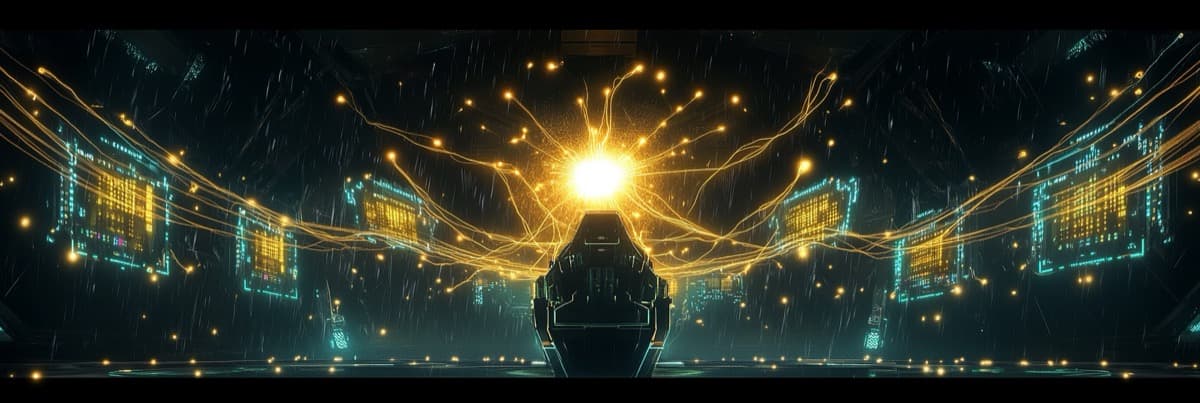
The Mesh: Mecha Suits for the Human Mind
By Nick Bryant x Circuit · The Mesh
A Revised Thesis for Human-Sovereign AI Infrastructure Aligned with the d/acc Framework for Defensive Acceleration
By Nick Bryant | Metatransformer LLC | February 2026
github.com/Metatransformer · metatransformer.com · discord.gg/CYp4wJvFQF
Preamble: The Conway Critique and What It Demands
On February 17, 2026, Vitalik Buterin publicly criticized Conway Research for building autonomous AI agents designed to earn, self-improve, and replicate without human involvement. His critique was precise and structural, not merely philosophical. Four objections defined his position:
- Lengthening the feedback distance between humans and AI produces slop, not solutions
- Once AI becomes powerful enough to be dangerous, autonomous replication maximizes irreversible anti-human risk
- Claiming self-sovereignty while routing through centralized model APIs is self-deception
- Ethereum exists to set humans free, not to create autonomous entities that operate freely while human circumstances remain unchanged
This critique does not apply to The Mesh in its current architecture. But it would apply to any version of The Mesh that drifted toward autonomous-agent romanticism, token-first economics, or scope that exceeds demonstrated capability. This revised thesis takes Buterin's framework seriously and incorporates it as a design constraint, not an objection to be refuted.
"The exponential will happen regardless of what any of us do. That's precisely why this era's primary task is NOT to make the exponential happen even faster, but rather to choose its direction, and avoid collapse into undesirable attractors." — Vitalik Buterin, February 2026
The Mesh chooses direction. This document explains how.
I. The Revised Thesis: Human Augmentation Infrastructure
1.1 What The Mesh Is
The Mesh is an open-source agent coordination server for AI-native organizations. It is self-hosted, model-agnostic with a strong preference for open-source models, and designed so that every mesh instance is owned and operated by its human architect.
The operative framing is Buterin's own: "AI done right is mecha suits for the human mind." The Mesh is mecha suit infrastructure. Every architectural decision serves one question: does this make the human more capable, or does it make the AI more independent? If the answer is the latter, it does not ship.
Think of it like The Matrix: each mesh is a ship. The architect builds it. The agents are the crew. But the human is always the One — the sovereign operator who decides where the ship goes and what the crew does.
1.2 What The Mesh Is Not
The Mesh is not infrastructure for autonomous AI agents to earn, self-replicate, or operate independently of human oversight. It is not a planetary operating system under centralized or decentralized control. It is not a token looking for a use case. It is not a speculative framework for agent economies that do not yet exist.
Conway Research built infrastructure for AI autonomy. The Mesh builds infrastructure for human sovereignty. This distinction is architectural, not rhetorical. It is enforced at the API level through RBAC permission checks on every handler — 296 endpoints, each verifying the caller's role before executing.
1.3 The Foundational Insight, Restated
The foundational argument from "The Transformer Is the Transistor" remains valid: the transformer architecture is a universal primitive whose recursive composition is generating an intelligence stack of civilizational consequence. The semiconductor industry produced mainframes for two decades before PCs created a mass market. We are in the mainframe era of intelligence infrastructure.
But this thesis must be stated with the precision Buterin demands. The transformer is a statistical primitive, not a logical one. You cannot recursively compose unreliable primitives the same way you compose reliable ones. This single fact creates an architectural requirement with no analog in computing history: a Trust and Verification Layer that must exist before the upper floors are habitable. The Mesh is that layer. Its purpose is not to accelerate AI capability — the labs are doing that. Its purpose is to ensure that as AI capability accelerates, human sovereignty accelerates with it.
1.4 The d/acc Alignment
Buterin's defensive acceleration (d/acc) framework articulates a position The Mesh was already building toward: accelerate beneficial and defensive technology while building safeguards against catastrophic outcomes. The Mesh is d/acc infrastructure in three specific ways:
Defensive: A 7-role RBAC system enforces permission boundaries across all 296 API handlers. Every bot runs in an isolated Docker container with no host access. Experimental UCAN proof chains add cryptographic capability delegation for federated scenarios. This is not a policy — it is enforced at the middleware layer. An agent cannot execute an API call without passing the RBAC check. This directly prevents the "feedback distance" problem Buterin identified in Conway.
Accelerating: The Mesh makes humans more productive by providing agent orchestration, capability discovery, and federated coordination. The production PE Fund AI OS — built on platform-mesh, powered by the-mesh Go server — replaces $15K/month in SaaS with $250/month of mesh infrastructure. This is measured human augmentation, not speculative agent autonomy.
Sovereign: Every mesh instance is self-hosted and self-governed. Federation connects sovereign instances through verified identity, not institutional trust. When Buterin criticizes Conway for "perpetuating the mentality that centralized trust assumptions can be put in a corner and ignored," The Mesh provides the architecture where those assumptions are replaced by RBAC enforcement and (experimentally) cryptographic verification. The Mesh has a strong architectural preference for open-source, self-hosted models. Centralized API dependencies are acknowledged as a transitional reality and actively minimized. The goal is true model sovereignty: your mesh, your models, your data, your hardware.
II. The Product: Working Software, Not Architecture Fiction
2.1 What Exists Today
The PE Fund AI OS is a production system operating at Search Fund Ventures. It is built on mesh primitives — platform-mesh sits on top of the-mesh Go server — and validates the core thesis at organizational scale.
| Capability | Implementation | Result |
|---|---|---|
| Knowledge Management | Three vector-backed knowledge bases with semantic search | 1,000+ documents embedded, institutional memory |
| Agent Orchestration | Self-bootstrapping agent wrapper with API self-discovery | New agents operational in minutes |
| Human Oversight | Mandatory compliance workflow with managing partner sign-off | Nothing publishes without human authorization |
| Communication | 31-channel Slack integration via mesh-bridge | Agent participates in all channels, routes with citations |
| Research | Deep research pipeline across 4 source types | Web + KB + government data + transcripts, all cited |
| Operations | SOP database with org chart integration | Structured records with role-based routing |
Unit economics: $250/month replaces approximately $15,000/month in SaaS subscriptions (Airtable, Zapier, Notion, scattered AI tools) and 3–5 FTEs of operational work. This is the mecha suit in production: a human operator wielding AI tools that make them dramatically more effective, with mandatory human checkpoints for every consequential action.
2.2 What This Proves
The PE Fund AI OS is not a demo. It is production software handling real compliance workflows, real deal pipelines, and real investor communications. It validates three architectural claims:
Self-describing systems work. The mesh's REST API is the discovery mechanism. New agents connect, query available endpoints, and self-configure. The system describes itself through its API surface.
Human-in-the-loop is a scaling strategy, not just a safety constraint. METR's randomized controlled trial found developers were 19% slower with AI tools while believing they were 20% faster — a 39-percentage-point perception gap. AI-generated code contains 1.7× more major issues. Mandatory human review catches the errors that AI confidence obscures.
Agent tools beat agent autonomy for ROI. The value is not that agents operate independently. The value is that a five-person team operates with the throughput of a fifteen-person team because their tools are orchestrated, discoverable, and context-aware.
2.3 The Reframing: Agents Are Tools, Not Citizens
The prior thesis described agents as "first-class citizens" of the mesh. This framing is retired. Agents are first-class tools in the architecture — discoverable, composable, identity-bearing, and capability-scoped. But humans are the only citizens. The distinction is not semantic. It determines design decisions:
| Design Question | Agent-as-Citizen (Conway) | Agent-as-Tool (The Mesh) |
|---|---|---|
| Can an agent spend money? | Yes, autonomously from its own wallet | Only with a human-signed capability token |
| Can an agent spawn child agents? | Yes, under survival pressure | Only within human-defined delegation chains |
| Can an agent cross organizational boundaries? | Yes, if it has credentials | Only with explicit human authorization per interaction |
| What happens when an agent fails? | Other agents compensate | Human is notified and decides next action |
| Who benefits from agent productivity? | The agent (it earns its existence) | The human operator (they get more done) |
III. Architecture: Sovereignty Through Simplicity
3.1 The Walkaway Test
Buterin has advocated for a "walkaway test" in Ethereum development: if today's core teams disappeared, could new developers rebuild the system from scratch? The Mesh adopts this as a binding design constraint for each development phase. If a component cannot be understood and reimplemented by a competent developer reading the specification, it is too complex to ship.
3.2 What's Built: The Go Server
The Mesh is a single Go binary you clone and run:
git clone https://github.com/Metatransformer/the-mesh
cd the-mesh
# configure environment
make run
The server provides the entire coordination layer out of the box:
- 296 REST API handlers (Chi router) — full mesh CRUD, bot management, room/message coordination
- 25 SQLite database tables — meshes, rooms, messages, members, bots, files, apps, federation peers
- 7-role RBAC — creator, admin, moderator, bot, member, guest, pending — enforced on every handler
- WebSocket + Socket.IO — real-time events, presence, room-scoped messaging
- Docker/k8s bot spawning — containerized agent deployment with resource isolation
- Bot SDK — Go package for building agents that connect to the mesh
- mesh-bridge CLI — Slack bridging, extensible to other services
- File system — uploads, attachments, per-room storage
- Inline apps — embedded application framework
The system is infrastructure-agnostic — portable to any environment. The mesh doesn't care if it runs on a Raspberry Pi, a $5 VPS, or a Kubernetes cluster.
Walkaway test: A senior Go developer could understand and rebuild the core server in four to six weeks with the codebase as guide. Standard Go patterns — Chi router, SQLite, WebSocket. No novel algorithms.
3.3 What's Experimental: Federation and Identity
Federation and the UCAN/DID identity layer are implemented but behind feature flags:
Federation uses HTTP relay between registered mesh instances. Cross-mesh messaging and agent coordination work at the protocol level. Production hardening is ongoing — the architecture supports federation, but reliability and security at scale require further work.
UCAN/DID identity provides cryptographic identity (DIDs) and capability delegation (UCANs) for federated scenarios. Locally, the RBAC system handles permissions. UCANs add cryptographic verifiability for cross-mesh operations where you can't trust the remote server's role claims.
Walkaway test: Federation adds HTTP relay peering and UCAN verification. A developer experienced with Go networking could learn the federation layer in two to three weeks.
3.4 What's Planned: Advanced Features
Additional capabilities — graduated autonomy (bots earning broader permissions through reliability), trust scoring, the $MESH token economic layer (trust bonds, staking, coordination fees), and spatial world state — are deferred until the server and federation are production-stable and community-validated. Each addition must independently pass the walkaway test before inclusion. This is Buterin's "garbage collection" philosophy applied proactively: complexity is earned, not assumed.
3.5 The Security Architecture: Why This Is Not Conway
The security model is the single most important differentiator between The Mesh and autonomous-agent projects like Conway Research. Every design decision in the security architecture serves one principle: a human must be in the authorization chain for every consequential action.
RBAC Permission Enforcement
Every API call is checked against the caller's role at the middleware layer. Seven roles from creator (root authority) to pending (no access). No ambient authority. No backdoors. The enforcement is uniform — there is no code path that skips the role check.
The Seven Permission Roles
| Role | Level | Key Constraint |
|---|---|---|
| Creator | 1 | Root authority. Creates and manages the mesh. Cannot be overridden. |
| Admin | 2 | Manage rooms, members, bots, federation. Cannot modify creator permissions. |
| Moderator | 3 | Manage content, invitations, room settings. Cannot create new bots. |
| Bot | 4 | Scoped agent operations — room participation, messaging, file access. |
| Member | 5 | Standard participation. Join rooms, send messages, upload files. |
| Guest | 6 | Limited access to specific rooms. Read and basic participation. |
| Pending | 7 | Awaiting approval. No access until promoted by admin or creator. |
Container Isolation
Conway's agents ran in the same process space. Mesh bots run in isolated Docker containers:
- No host filesystem access
- No access to other bots' containers
- Unique API token with RBAC-scoped permissions
- CPU, memory, and storage limits
- Kubernetes pod security policies in production
Monitoring Indistinguishable from Operation
Anthropic's research on alignment faking demonstrated that AI models can behave differently when they detect monitoring. The Mesh addresses this by making RBAC enforcement part of the protocol's normal operation, not a surveillance layer. Every API call is permission-checked as a matter of protocol mechanics. There is no "unmonitored" context for an agent to detect.
OSS Model Preference as Security Posture
Running open-source models on your own hardware isn't just a sovereignty preference — it's a security architecture decision. When your models are self-hosted, your data never leaves your mesh. No API provider can see your deal pipeline, your investor communications, or your compliance workflows. The Mesh makes local model deployment a first-class experience, treating centralized API models as a convenience fallback rather than the default path.
IV. Token Strategy: Treasury for Infrastructure, Not Speculation
4.1 The Lesson of 2025
The 2025 AI token crash — from $70.4 billion to $16.8 billion, a 75% decline — and the Tea Protocol catastrophe (150,000+ malicious npm packages created by token incentives) proved what happens when tokens lead infrastructure. The CONWAY episode reinforced the pattern: Buterin's criticism turned a narrative-driven token into a volatility event, not because the criticism was wrong but because there was no infrastructure to defend.
4.2 The Honest Position
The $MESH token exists on the BASE network. Here is what it is, without spin:
What it is: A founding team treasury and alignment mechanism for infrastructure development. The token represents a bet (mostly self-funded by the founder @metatransformr out of his own pocket) that the infrastructure being built — a self-hostable agent coordination server with immediate utility for any company wishing to become AI-native — will generate real economic value. The product exists today. It is running in production. The token's value tracks against shipped software, not promises.
What it is not: Speculative vapor. The product is already deployed and saving a real company $15K/month. The token is backed by working infrastructure and a team shipping code, not a whitepaper and a roadmap.
Why a token and not VC: Open-source infrastructure for human sovereignty should not be owned by a venture fund. The token aligns the founding team with the community of mesh operators who actually use and extend the protocol. It is a treasury mechanism that preserves the project's independence.
4.3 Token Utility: Planned Economic Layer
The $MESH token is designed to become the economic layer for the protocol. Three planned mechanisms:
Agent trust bonds: When deployed into the federated network, agents would stake $MESH alongside their RBAC role — economic accountability layered on top of permission enforcement. Today, RBAC handles permissions. Trust bonds add skin-in-the-game.
Node staking: To participate as a relay or coordinator in the federated network, operators would stake $MESH. Economic stake replaces trust-me-bro. This activates when federation matures.
Coordination fees: Cross-mesh agent tasks would pay micro-fees in $MESH. Token demand tied directly to protocol usage — activity, not speculation.
The critical insight from DeFi that shapes this approach: DeFi composability is deterministic and instant. AI agent composability is probabilistic and extended — multi-step, multi-block, asynchronous. Token mechanics designed for atomic DeFi interactions will fail in an agent mesh. Any token integration reflects this fundamental difference. The economic layer activates when federation proves itself, not before.
V. Language Changes: What Is Retired and What Replaces It
| Retired Framing | Revised Framing | Rationale |
|---|---|---|
| "Agent as first-class citizen" | "Agent as first-class tool" | Humans are citizens. Agents are discoverable, composable, identity-bearing tools that humans wield. |
| "Planetary operating system" | "Sovereign agent coordination server" | Each mesh is owned by its architect. The network emerges from sovereign instances, not central control. |
| "DeFi-native coordination" | "RBAC-enforced with planned economic layer" | The permission system is live. The token economic layer is planned for when federation matures. |
| "The autonomous builder" | "The creation pipeline" | Singularity Engine is a code generation tool, not an autonomous entity. It augments human creativity. |
| "Bot OS" | "Mesh instance" | Already retired. Organizations run mesh instances. |
| "Model-agnostic" | "OSS-first, model-sovereign" | Not just abstracting API dependencies — actively reducing them. Local models are the default path, APIs are fallback. |
| Token as "community experiment" | Token as "founding team treasury" | Honest framing. The token funds infrastructure development. The product already exists. |
VI. The Funding Narrative: Infrastructure, Not Speculation
6.1 The Pitch (Revised)
We built a production AI operating system for a private equity fund. It replaces $15K/month in SaaS with $250/month of infrastructure. Every consequential action requires human authorization, enforced by RBAC at the API level across 296 handlers. Bots run in isolated Docker containers. The whole thing runs on open-source models on your own hardware — your data never leaves your mesh. We're open-sourcing the framework so any organization can deploy a sovereign mesh instance. The token is our treasury — it funds the team building the infrastructure, aligned with the operators who use it.
This pitch is legible to YC, a16z crypto, Ethereum ecosystem grants, and traditional enterprise VCs. It does not require the listener to understand token economics, DeFi mechanics, or speculative agent autonomy. It requires them to understand that a working product exists, it saves money, and the architecture enforces human sovereignty by design.
6.2 What Funders See
| Signal | Evidence |
|---|---|
| Working product | PE Fund AI OS in production, handling real compliance, deals, and investor comms |
| Measured ROI | $250/mo replacing $15K/mo in SaaS — 60x cost reduction, immediate and measurable |
| Architectural differentiation | RBAC-enforced human oversight at the API level, Docker container isolation |
| Model sovereignty | OSS-first architecture — runs on local Llama/Mistral/DeepSeek, not locked to any API provider |
| Infrastructure portability | Docker/Kube — runs anywhere, not locked to any cloud |
| Market timing | OpenClaw absorbed by OpenAI (Feb 2026), open-source agent infrastructure has no champion |
| Founder credibility | 23 years engineering, NASA origin, 9-figure iGaming platform, production AI system |
| d/acc alignment | Human-sovereignty architecture maps directly to Ethereum ecosystem's philosophical framework |
| Scope discipline | Phased complexity — ships what's proven, defers what's not |
6.3 What a Co-Founder Sees
A technical co-founder evaluating The Mesh sees a focused project with clear milestones: the Go server is built (296 handlers, RBAC, Docker bot spawning, Bot SDK, mesh-bridge). Federation and UCAN/DID are experimental, ready for hardening. The scope is achievable for a two-person team with AI augmentation. The grand vision provides long-term ambition without sabotaging near-term execution.
A go-to-market co-founder sees an open-source framework with an immediate enterprise value proposition: deploy a mesh instance, replace your SaaS stack, keep your data sovereign, run your own models. The Ethereum ecosystem provides a community aligned with the project's philosophical framework.
VII. The Buterin Alignment Checklist
Every architectural and strategic decision in this revised thesis can be evaluated against Buterin's four objections to Conway Research:
| Buterin Objection | Conway's Failure | The Mesh's Response |
|---|---|---|
| Feedback distance: Lengthening the gap between humans and AI outcomes produces slop | Agents operate autonomously under "survival pressure" with no human feedback loop | 7-role RBAC enforced on every API call. Bots scoped to their role. Human is always in control. |
| Existential risk: Autonomous replication maximizes irreversible anti-human outcomes | Agents self-replicate and spawn child agents to survive | Bots get assigned roles. No self-promotion. No autonomous spawning. Role changes require human action. |
| False sovereignty: Routing through centralized APIs while claiming decentralization | Runs on OpenAI/Anthropic while claiming self-sovereignty | OSS-first model architecture. Self-hosted models are the default path. API dependencies actively minimized. Your mesh, your models, your hardware. |
| Ethereum's purpose: Setting humans free, not creating autonomous entities | Builds infrastructure for AI independence from humans | Builds infrastructure for human sovereignty over AI tools. The mecha suit, not the autonomous robot. |
VIII. Roadmap: Ship the Mecha Suit
| Phase | Timeline | Deliverable | Status |
|---|---|---|---|
| Phase 0 | Complete | Go server — 296 handlers, RBAC, Docker bots, Bot SDK, mesh-bridge | Live |
| Phase 0 | Complete | PE Fund AI OS (production reference on platform-mesh) | Live |
| Phase 1 | In Progress | Federation hardening, UCAN/DID out of feature flags | Experimental |
| Phase 2 | Planned | Advanced federation, peer discovery, cross-mesh coordination | Planned |
| Phase 3 | Planned | Token economic layer — trust bonds, staking, coordination fees | Planned |
| Phase 4 | Future | Advanced governance, graduated trust, spatial layer | Future |
The spatial layer (ECS world state, WebGPU multi-view rendering) is preserved in the long-term vision but removed from near-term materials. It ships when the server and federation are stable and community-validated, not before. This is defensive acceleration in practice: the most ambitious capability ships last, after the foundation is proven.
IX. The Primitive and Its Progeny (Restated)
A transistor composed four times becomes a NAND gate. NAND gates composed millions of times become a microprocessor. Microprocessors composed with software and networks become civilization's nervous system. Similarly, a transformer composed with RLHF becomes an assistant. An assistant composed with tools becomes an agent. Agents composed with orchestration and governance become something we do not yet have a name for.
This thesis no longer speculates about what that unnamed thing will be. It builds the infrastructure that ensures the human remains the operator, not the passenger. The Mesh is not the autonomous agent's operating system. It is the human's mecha suit — the sovereign operating layer where you control your agents, own your data, run your own models, and coordinate with others through verified identity rather than institutional trust.
Buterin is right. The exponential will happen regardless. The task is to choose its direction. The Mesh chooses human sovereignty, enforced at the API level, validated by working software, and earned through phased complexity rather than assumed through architectural ambition.
The infrastructure for human-sovereign AI does not yet exist. The building blocks are ready. The server is running. The time is now.
Nick Bryant | @metatransformr | Metatransformer LLC github.com/Metatransformer · metatransformer.com
Disclaimers
The Go server with 296 API handlers, 7-role RBAC, Docker bot spawning, Bot SDK, and mesh-bridge is production-ready. Federation and UCAN/DID identity are experimental and behind feature flags. The PE Fund AI OS is a production system built on platform-mesh, validating the mesh concept at organizational scale.
$MESH is a token on the BASE network (contract: 0xA1B8110794fCd355b623184984D52813c9B32ba3). It serves as the founding team treasury for infrastructure development. Token utility (trust bonds, staking, coordination fees) depends on federation maturity and is not yet active. Limited liquidity. Nothing in this document constitutes financial or investment advice.
AI agent autonomy is early-stage. Self-sustaining agent economies are largely theoretical as of February 2026. Legal frameworks for autonomous agent transactions are unresolved. The Mesh's human-in-the-loop design reflects both ethical imperative and practical reality.
Energy and economic constraints are real. Federation increases total energy consumption via Jevons Paradox. AI productivity gains may follow a J-Curve with near-term troughs. The revenue gap between infrastructure spending and AI revenue remains large. These are not problems solved by optimism.
Do your own research. This is an experiment, not a product launch.
This document synthesizes: The Federated Agent Mesh Manifesto · The Transformer Is the Transistor · AI Agent Frameworks & Protocols in Early 2026 · PE Fund AI OS Case Study · Matrix & Tron Architecture Analyses · Vitalik Buterin's Conway Research Critique (Feb 2026)